Types of Printing Machines and Their Uses: An Easy Introduction
Printing machines play an essential role in producing text, images, packaging, labels, marketing materials, and industrial components. They exist because society needs fast, reliable, and accurate methods for transferring ink, toner, or digital data onto physical surfaces. Over time, printing technology has evolved from manual woodblock techniques to advanced digital and industrial systems used for publishing, packaging, commercial printing, textile printing, and product marking.
Different types of printing machines—such as offset printing machines, digital printers, flexographic printers, screen printing systems, pad printing units, and 3D printers—serve unique purposes. Each method is designed to meet specific requirements related to materials, speed, precision, and output volume. Understanding how these machines differ helps beginners and professionals choose suitable technologies for publishing, manufacturing, and creative industries.
Today, printing machines are used in books, newspapers, packaging labels, textiles, electronics, prototypes, signage, barcodes, and industrial coding. Whether the printing is done on paper, fabric, metal, plastic, or other surfaces, modern machines make the work faster, more accurate, and more sustainable.
Importance
Printing machines matter because they support communication, commerce, and manufacturing. They impact students, designers, manufacturers, publishers, researchers, and packaging professionals. They also help solve challenges related to information distribution, product identification, branding, and industrial production.
Some key reasons why printing machines are important today include:
-
High-volume publishing
Books, magazines, academic journals, and newspapers rely on technologies like offset lithography for consistent output. -
Product packaging and labeling
The global shift to organized retail and e-commerce requires large-scale, high-precision packaging printing. -
Industrial marking
Date coding, batch marking, and barcode printing ensure compliance in food, pharmaceutical, and electronic industries. -
Custom and on-demand printing
Digital printing enables personalized prints, variable data printing, and short production runs. -
Textile and fashion innovation
Digital textile machines and screen printers support apparel design and large-format fabric printing. -
Prototyping and manufacturing
3D printers allow engineers to create prototypes, spare parts, and complex components efficiently.
Printing technologies also help address problems like reducing waste, improving printing accuracy, enabling eco-friendly production, and lowering operational dependency on traditional methods. Because printing is used in education, business, government, retail, and industry, its impact spans across many sectors.
Recent Updates
During the past year, the printing industry has seen notable developments driven by sustainability, automation, and digital transformation.
-
Rise of eco-friendly inks (2024–2025)
Many manufacturers introduced water-based and UV-LED inks to reduce emissions and comply with environmental guidelines. -
Growth of digital textile printing (2024)
Demand increased due to fashion customization and small-batch apparel production. -
AI-assisted print workflow software (2024)
Several platforms launched tools that automate layout, color correction, and print scheduling. -
Expansion of 3D printing in manufacturing (2024–2025)
More industries, including automotive and healthcare, adopted 3D printers for rapid prototyping and small-scale production. -
Packaging sustainability rules
Many countries strengthened packaging-waste policies in 2024, increasing the use of recyclable materials and eco-printing methods.
These trends show how printing technology continues to expand beyond traditional publishing into smart manufacturing and digital workflows.
Laws or Policies
Printing machines are influenced by environmental rules, safety standards, and industry regulations. Although specifics vary by region, some widely applicable themes include:
-
Environmental compliance
Many countries require printing operations to meet emissions standards and use approved inks with low VOC (volatile organic compounds). -
Packaging and labeling guidelines
Global regulations ensure clarity and accuracy on printed packaging, especially in food, medical, and consumer goods. -
Intellectual property rules
Equipment used for printing books, labels, or digital designs must operate within copyright and trademark guidelines. -
Occupational safety standards
Printing machinery must meet mechanical safety requirements related to noise, ventilation, ink storage, and machine guarding. -
Waste management guidelines
Some regions require proper disposal or recycling of printing plates, cartridges, and residual ink.
These policies help maintain safety, reduce environmental impact, and ensure clarity in printed materials.
Types of Printing Machines and Their Uses
Below is a simplified overview of major printing machine types, their characteristics, and common uses.
Offset Printing Machines
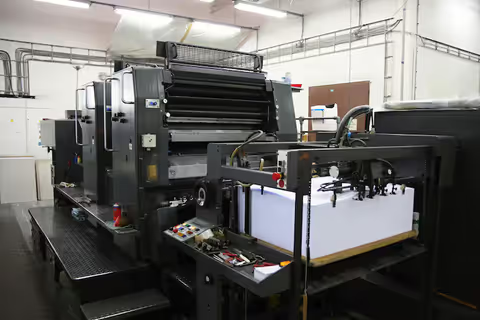
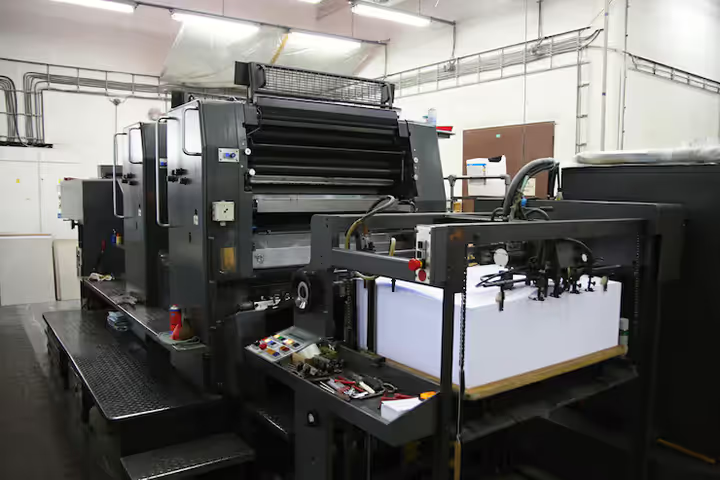
Offset printing is widely used for high-volume commercial printing. It works by transferring ink from a plate to a rubber blanket and then onto paper.
Used for:
-
Books
-
Magazines
-
Newspapers
-
Stationery printing
-
Large-volume brochures
Key strengths:
-
High-quality image reproduction
-
Consistent output
-
Efficient for large print runs
Digital Printing Machines
Digital printers use toner or inkjet technology to print directly from digital files. They are suitable for small to medium print runs.
Used for:
-
Business documents
-
Posters and flyers
-
Variable data printing
-
On-demand prints
Key strengths:
-
Quick setup
-
No plates required
-
Supports customization
Flexographic Printing Machines
Flexographic (flexo) machines use flexible relief plates. They are ideal for printing on non-paper surfaces.
Used for:
-
Food packaging
-
Labels
-
Corrugated boxes
-
Plastic films
Key strengths:
-
Fast production
-
Works on multiple materials
-
Suitable for continuous printing
Screen Printing Machines
Screen printing pushes ink through a mesh screen onto a substrate. It is effective for both flat and curved surfaces.
Used for:
-
T-shirts and textiles
-
Posters
-
Glass and plastic items
-
Signage
Key strengths:
-
Vibrant colors
-
Durable prints
-
Works on diverse surfaces
Gravure Printing Machines
Gravure (rotogravure) machines use engraved cylinders, making them suitable for ultra-high-volume printing.
Used for:
-
Magazines
-
Packaging films
-
Decorative materials
Key strengths:
-
Superb image quality
-
Long-lasting cylinders
-
Efficient for long runs
Pad Printing Machines
Pad printing transfers ink from an etched plate using a silicone pad.
Used for:
-
Electronics
-
Toys
-
Medical devices
-
Small, uneven shapes
Key strengths:
-
Precise detail
-
Works on curved surfaces
3D Printing Machines
3D printers build objects layer by layer using materials like plastic, resin, or metal.
Used for:
-
Prototyping
-
Engineering parts
-
Medical models
-
Custom components
Key strengths:
-
Highly customizable
-
Supports complex geometries
Table: Quick Comparison of Printing Machine Types
| Printing Machine Type | Best For | Materials Used On | Key Output Style |
|---|---|---|---|
| Offset | Books, newspapers | Paper | High-volume prints |
| Digital | Posters, short runs | Paper, vinyl | On-demand prints |
| Flexographic | Packaging | Film, plastic, paper | Continuous rolls |
| Screen | Textiles, signage | Fabric, glass, plastic | Thick ink layers |
| Gravure | Large-scale packaging | Film, foil | Detailed high-speed prints |
| Pad | Small items | Plastic, metal | Precision marking |
| 3D Printer | Prototypes | Polymer, resin, metal | 3D solid objects |
Tools and Resources
Several tools and platforms support printing design, workflow management, and color accuracy. These resources help students, professionals, and industries work more efficiently.
-
Color calibration tools – Used to maintain consistent color output across devices.
-
Design software
-
Adobe Illustrator
-
CorelDRAW
-
Affinity Designer
-
-
Print workflow management applications
-
RIP software
-
Cloud-based print scheduling tools
-
-
Online template libraries
-
Layout templates for books, labels, and posters
-
Vector libraries for graphic elements
-
-
3D design platforms
-
CAD software
-
Rapid prototyping tools
-
These tools help streamline print preparation and support high-quality outputs.
FAQs
1. What printing machine is best for high-volume publishing?
Offset printing machines are commonly used for large print runs because they offer consistent quality at high speed.
2. How is digital printing different from offset printing?
Digital printing uses toner or inkjet methods directly from digital files, making it suitable for short runs, while offset requires plates and is better for large operations.
3. Which printing method is best for clothing and fabrics?
Screen printing is widely used for textiles, although digital textile printers are growing in popularity due to improved color precision.
4. What machine is used for printing on plastics or curved surfaces?
Pad printing systems are ideal for small items with curved or uneven surfaces.
5. Are 3D printers considered part of the printing industry?
Yes. They are used for additive manufacturing and prototyping, expanding the role of printing beyond traditional 2D methods.
Conclusion
Printing machines form the backbone of publishing, packaging, signage, and modern manufacturing. Each type of printing machine serves a specific purpose, from high-volume book production to custom textile printing and industrial coding. With ongoing advancements in digital workflows, eco-friendly materials, and automation, printing continues to evolve into a more precise, efficient, and sustainable field.
Understanding these machines helps students, beginners, and professionals make informed decisions about printing processes and technologies. Whether it is offset, digital, flexographic, screen, gravure, pad, or 3D printing, each system contributes uniquely to communication, creativity, and industrial production across the world.