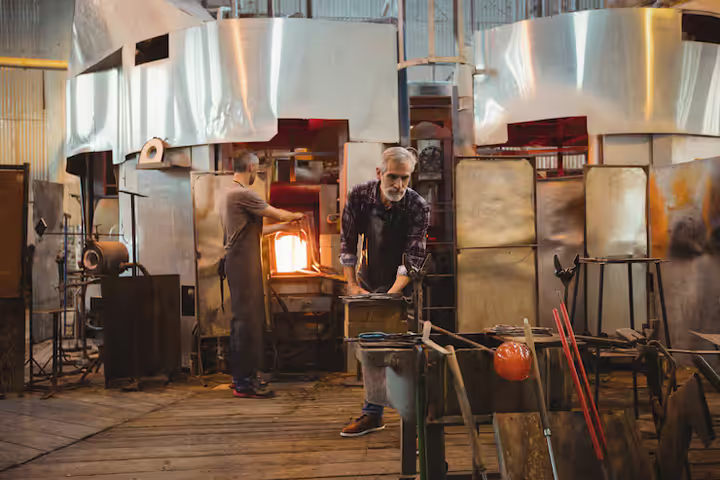
Industrial Furnaces in Modern Manufacturing: A Practical Guide
Industrial furnaces are essential systems used in modern manufacturing to heat materials to high temperatures for processing, shaping, strengthening, or chemical transformation. They are designed for controlled thermal treatment in industries such as steel production, automotive manufacturing, aerospace engineering, ceramics, electronics, and advanced materials processing.
In simple terms, an industrial furnace is a high-temperature heating system built to perform specialized thermal operations. These may include melting metals, heat treatment, forging, sintering, calcining, annealing, and stress relieving. Unlike domestic heating equipment, industrial furnaces are engineered for continuous operation, energy efficiency, safety compliance, and precise temperature control.
Industrial heating technology exists because many manufacturing processes require specific thermal conditions to alter material properties. For example, steel must be heated and cooled in controlled environments to achieve required strength and durability. Similarly, glass and ceramics must be processed at carefully managed temperatures to ensure structural integrity and performance.
Today’s industrial furnaces combine mechanical engineering, digital automation, thermal insulation systems, and environmental control technologies. As manufacturing becomes more advanced and energy regulations tighten, furnace systems are evolving to meet modern efficiency and sustainability standards.
Why Industrial Furnaces Matter in Today’s Economy
Industrial furnaces play a direct role in infrastructure development, transportation systems, renewable energy equipment, and consumer goods production. Nearly every manufactured metal component has undergone some form of thermal processing.
The importance of industrial furnace technology can be understood through several key factors:
• Enables production of high-strength alloys and engineered materials
• Supports automotive and aerospace manufacturing
• Facilitates renewable energy equipment production, including wind turbine components
• Enhances durability and corrosion resistance in industrial parts
• Improves manufacturing precision and quality control
Manufacturers rely on industrial furnace systems to maintain consistent production output while meeting strict quality standards. Modern supply chains require predictable performance, and thermal processing accuracy directly affects product reliability.
From a macroeconomic perspective, furnace technology contributes to industrial productivity, export competitiveness, and technological innovation. Industries such as metallurgy, semiconductor fabrication, and advanced ceramics depend on controlled high-temperature environments.
Common Types of Industrial Furnaces
Different manufacturing processes require different furnace designs. The table below summarizes common types and their primary applications.
| Furnace Type | Primary Application | Typical Temperature Range |
|---|---|---|
| Electric Arc Furnace | Steel production | Up to 1,800°C |
| Induction Furnace | Metal melting | 1,000–1,600°C |
| Gas-Fired Furnace | Heat treatment | 300–1,200°C |
| Vacuum Furnace | Aerospace components | 800–1,300°C |
| Rotary Kiln | Cement and minerals | 800–1,500°C |
Electric arc furnaces are widely used in steel recycling operations. Induction furnaces rely on electromagnetic energy to generate heat. Vacuum furnaces provide oxygen-free environments, critical for aerospace-grade alloys.
Each design supports industrial process optimization and material performance enhancement.
Recent Updates and Industry Trends
Industrial furnace technology has experienced notable developments in 2025, driven by sustainability targets, automation integration, and energy efficiency mandates.
In January 2025, several industrial manufacturing associations reported increased adoption of electric heating systems to reduce carbon emissions. Electrification of furnace systems has become a major trend, especially in regions transitioning away from fossil fuel dependency.
In March 2025, updates to energy efficiency benchmarking guidelines in multiple industrial economies emphasized improved combustion monitoring systems and digital thermal analytics. Smart sensors and Industrial Internet of Things (IIoT) integration are becoming common features in new furnace installations.
Key trends observed in 2025 include:
• Increased integration of AI-driven temperature control systems
• Real-time energy consumption analytics
• Carbon emission monitoring technologies
• Adoption of hydrogen-compatible furnace burners
• Advanced refractory insulation materials for reduced heat loss
Manufacturers are also exploring hybrid furnace designs that combine electric and gas heating to improve operational flexibility.
These developments aim to balance productivity with environmental compliance, aligning with global industrial decarbonization goals.
Environmental and Regulatory Considerations
Industrial furnaces are subject to strict environmental and safety regulations. High-temperature operations generate emissions, energy consumption, and safety risks that must be carefully managed.
In the United States, regulatory oversight is guided by agencies such as the Environmental Protection Agency. Emission standards under the Clean Air Act influence combustion efficiency requirements and pollutant monitoring.
Within the European Union, environmental compliance aligns with the Industrial Emissions Directive, supervised by the European Commission. Manufacturers must track carbon intensity and adhere to energy efficiency targets.
In India, industrial emission guidelines are regulated by the Central Pollution Control Board, which establishes air quality standards and furnace-related environmental limits.
Common regulatory themes include:
• Air emission monitoring
• Energy efficiency compliance reporting
• Workplace safety standards
• Hazardous material management
• Industrial carbon reduction targets
Failure to meet environmental regulations can lead to operational restrictions or penalties. As a result, manufacturers increasingly invest in emission control systems, waste heat recovery units, and advanced monitoring software.
Energy Efficiency and Sustainability
Energy efficiency is a major consideration in industrial furnace operation. Furnaces are among the highest energy-consuming systems in heavy manufacturing. Improving efficiency reduces operational expenses and environmental impact.
The chart below illustrates simplified industrial energy usage distribution in heavy manufacturing environments.
Industrial Energy Consumption Distribution (Illustrative)
Thermal Processing: 45%
Machinery Operation: 30%
Lighting and Auxiliary Systems: 15%
Other Utilities: 10%
Because thermal processing accounts for a large share of industrial energy use, furnace optimization directly influences overall plant efficiency.
Common energy-saving strategies include:
• Regenerative burner systems
• Heat recovery systems
• High-performance refractory linings
• Automated combustion control
• Predictive maintenance software
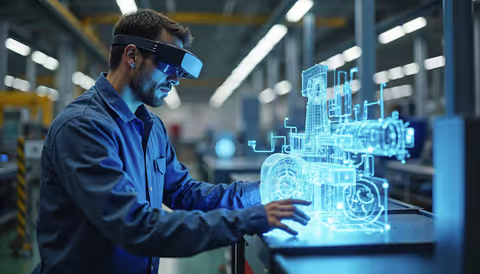
Digital transformation is also reshaping furnace monitoring. Industrial data analytics platforms allow engineers to track temperature deviations, detect inefficiencies, and reduce downtime.
Tools and Resources for Industrial Furnace Management
Modern furnace management relies on specialized software, technical resources, and analytical tools.
Key tools include:
• Energy consumption monitoring platforms
• Industrial automation systems (PLC-based control systems)
• Thermal modeling software
• Carbon footprint calculators
• Predictive maintenance analytics tools
Technical standards and guidelines are available from organizations such as:
• International Organization for Standardization
• American Society for Testing and Materials
• International Energy Agency
Manufacturers also consult engineering handbooks, industrial compliance portals, and environmental reporting platforms for documentation and regulatory alignment.
Educational institutions and technical research centers publish white papers on advanced industrial heating systems, automation integration, and emission reduction technologies.
Safety and Operational Risk Management
Industrial furnaces operate at extreme temperatures and require strict safety procedures. Risks include overheating, equipment failure, combustion hazards, and material handling injuries.
Risk mitigation strategies typically include:
• Automated shutdown systems
• Fire-resistant insulation materials
• Gas leak detection sensors
• Operator training programs
• Scheduled maintenance protocols
Digital monitoring systems can reduce risk by identifying abnormal temperature fluctuations or mechanical wear before critical failures occur.
Frequently Asked Questions
What is the primary purpose of an industrial furnace?
An industrial furnace is designed to heat materials to controlled high temperatures for processes such as melting, annealing, sintering, and heat treatment. It ensures precise thermal control in manufacturing environments.
How do electric furnaces differ from gas-fired furnaces?
Electric furnaces use electrical energy to generate heat, often providing cleaner operation and precise temperature control. Gas-fired furnaces rely on combustion and are common in high-capacity heat treatment processes.
Why are industrial furnaces regulated by environmental authorities?
Furnaces can produce emissions and consume significant energy. Regulations ensure air quality protection, energy efficiency, and workplace safety compliance.
What industries rely most on industrial furnace technology?
Steel manufacturing, automotive production, aerospace engineering, ceramics, cement production, electronics fabrication, and renewable energy component manufacturing depend heavily on furnace systems.
How is digital technology improving furnace efficiency?
Digital sensors, data analytics platforms, and automation software allow real-time monitoring, predictive maintenance, and optimized temperature control, reducing energy waste and downtime.
Conclusion
Industrial furnaces remain foundational to modern manufacturing and industrial engineering. They enable the production of high-performance materials, infrastructure components, transportation systems, and advanced technologies.
As environmental standards tighten and industries pursue carbon reduction goals, furnace systems are undergoing rapid technological transformation. Electrification, hydrogen-compatible burners, digital automation, and energy analytics platforms are shaping the next generation of industrial heating systems.
Regulatory frameworks across major economies continue to influence design standards, emission controls, and efficiency benchmarks. Manufacturers must balance operational productivity with environmental responsibility.
Understanding industrial furnace technology is increasingly important for engineers, plant managers, environmental compliance professionals, and policy analysts. With ongoing innovation in energy-efficient manufacturing and digital industrial solutions, furnace systems will continue to evolve alongside global industry demands.