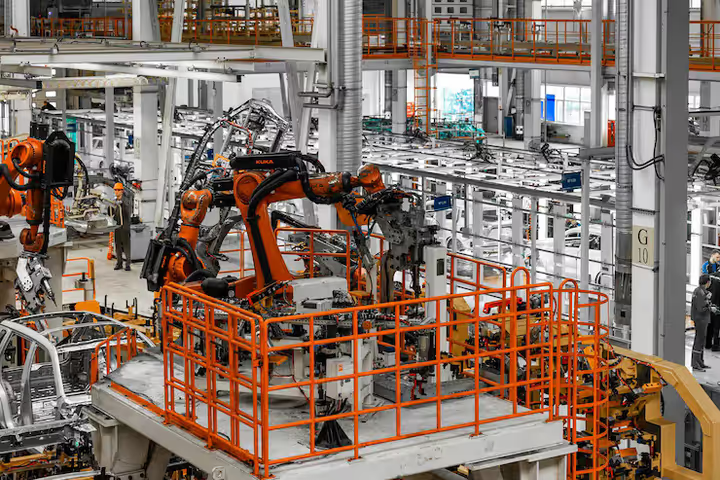
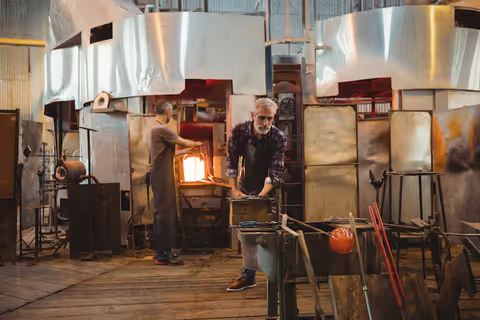
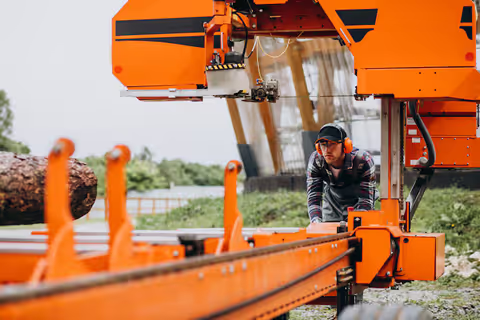
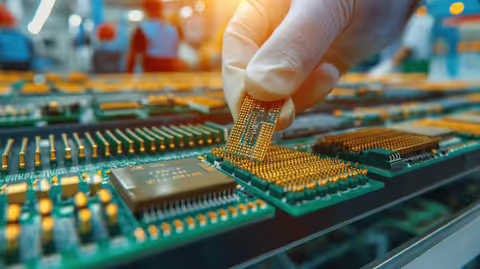
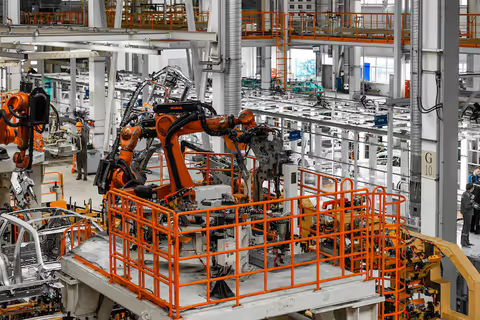
Over time, industrial equipment has evolved from manual mechanical tools to advanced automation systems powered by artificial intelligence, robotics, and data analytics. Today, smart manufacturing environments rely on interconnected machinery that communicates in real time through digital networks.
Industrial equipment exists because modern industries require large-scale, reliable production. Manual processes alone cannot meet global demand for goods, infrastructure, and energy. From assembly line robots to heavy construction machinery, equipment supports industrial growth and economic development.
Common categories include:
-
Heavy machinery used in construction and mining
-
Manufacturing equipment for production lines
-
Industrial automation systems
-
Robotics and control systems
-
Material handling and logistics systems
-
Process equipment used in chemical and energy industries
The shift toward industrial automation technology reflects the growing need for precision, safety, and manufacturing process optimization in competitive global markets.
Why Industrial Equipment Matters Today
Industrial equipment plays a central role in economic productivity and infrastructure development. Nearly every product—whether electronics, vehicles, textiles, or packaged food—relies on machinery at some stage of production.
Modern industries face several challenges:
-
Increasing demand for efficiency
-
Rising energy consumption
-
Workplace safety concerns
-
Environmental sustainability requirements
-
Supply chain disruptions
Advanced automation systems help address these issues by improving accuracy, reducing downtime, and enhancing predictive maintenance strategies.
For example, predictive maintenance uses sensor data and analytics to detect equipment wear before failure occurs. This approach reduces unexpected shutdowns and improves overall equipment effectiveness (OEE).
Below is a simplified comparison of traditional machinery and smart industrial systems:
| Feature | Traditional Machinery | Smart Industrial Systems |
|---|
| Monitoring | Manual inspections | Real-time sensor data |
| Maintenance | Reactive repairs | Predictive maintenance |
| Efficiency | Fixed output | Adaptive optimization |
| Connectivity | Standalone | Integrated networks |
| Data Use | Limited | Advanced analytics |
Industrial automation also supports workplace safety. Automated control systems reduce human exposure to hazardous environments, particularly in chemical plants, mining operations, and heavy manufacturing facilities.
Additionally, energy-efficient machinery contributes to carbon reduction goals by lowering electricity consumption and minimizing waste. This is especially important as industries work toward sustainability benchmarks and environmental compliance standards.
Recent Updates and Trends in Industrial Automation
The industrial sector has experienced rapid technological changes during 2024 and 2025. Several key developments are shaping the future of industrial equipment.
Expansion of Industry 4.0 Solutions (2024)
Manufacturers have increased adoption of Industry 4.0 solutions, integrating IoT-enabled machinery, cloud computing, and data-driven production systems. In early 2024, multiple global manufacturing reports highlighted increased investment in digital twin technology, which allows companies to simulate equipment performance before physical deployment.
Growth of AI-Powered Predictive Maintenance (2024–2025)
Throughout 2024, industrial firms expanded the use of machine learning models to analyze operational data. By mid-2025, many facilities reported measurable reductions in downtime through advanced predictive maintenance platforms.
Energy Efficiency and Electrification (2025)
In 2025, industries accelerated transitions toward electric-powered industrial equipment to reduce emissions. This shift aligns with international sustainability commitments and national energy transition programs.
Cybersecurity in Industrial Systems (2025)
As automation systems become interconnected, cybersecurity risks have increased. In 2025, industrial cybersecurity standards received greater attention, with organizations prioritizing secure industrial control systems (ICS) and operational technology (OT) protection.
These developments indicate a strong movement toward intelligent, connected, and sustainable manufacturing environments.
Laws and Policies Affecting Industrial Equipment
Industrial equipment is influenced by multiple regulatory frameworks that ensure safety, environmental protection, and operational standards. Regulations vary by country, but common categories include workplace safety, emissions standards, and machinery certification requirements.
In the United States, workplace safety standards are enforced by Occupational Safety and Health Administration (OSHA). OSHA establishes guidelines for machine guarding, hazard communication, and safe equipment operation.
In the European Union, machinery compliance is governed by the European Commission under the EU Machinery Regulation framework. Equipment must meet CE marking standards to ensure safety and performance compliance.
In India, industrial operations are regulated under the Factories Act and environmental guidelines overseen by the Ministry of Environment, Forest and Climate Change. These policies address emissions control, waste management, and industrial safety requirements.
Environmental policies worldwide increasingly encourage energy-efficient machinery and low-emission industrial systems. Carbon reporting frameworks and sustainability disclosure requirements now influence equipment upgrades and modernization decisions.
Companies operating internationally must comply with:
-
Workplace safety standards
-
Environmental impact regulations
-
Electrical and mechanical certification norms
-
Industrial cybersecurity guidelines
-
Emission and energy efficiency policies
Understanding these compliance standards is critical for risk management and operational continuity.
Tools and Resources for Industrial Equipment Management
Several digital tools and platforms support industrial process optimization and equipment management.
Common resources include:
-
Computerized Maintenance Management Systems (CMMS) for scheduling maintenance and tracking equipment history
-
Enterprise Resource Planning (ERP) systems for inventory and supply chain integration
-
Industrial IoT dashboards for real-time monitoring
-
Energy consumption calculators for efficiency analysis
-
Digital twin simulation software for testing operational performance
-
Compliance documentation templates for regulatory reporting
Example of a simple equipment maintenance tracking template:
| Equipment ID | Last Inspection | Condition | Next Check | Notes |
|---|
| MX-1001 | Jan 2026 | Stable | Apr 2026 | Routine lubrication |
| PR-2045 | Feb 2026 | Minor wear | Mar 2026 | Monitor vibration |
| CN-7780 | Jan 2026 | Optimal | May 2026 | No issues |
These tools help organizations improve data accuracy, reduce downtime, and maintain regulatory documentation.
Data visualization dashboards are also widely used in smart manufacturing facilities. A simplified conceptual performance trend might appear as:
Production Output Trend (Sample Representation)
Month: Jan Feb Mar Apr May
Output: 80 85 88 92 95
This upward trend may reflect automation improvements or optimized workflow systems.
Frequently Asked Questions
What is industrial equipment?
Industrial equipment includes machinery, automation systems, and tools used in manufacturing, construction, logistics, and energy sectors to produce goods efficiently and safely.
How does industrial automation improve productivity?
Industrial automation systems reduce manual intervention, increase accuracy, minimize downtime, and enable real-time monitoring, leading to better manufacturing process optimization.
What is predictive maintenance in industrial settings?
Predictive maintenance uses sensor data and analytics to detect potential equipment failures before they occur, helping reduce unexpected breakdowns and operational disruptions.
Are there environmental regulations for industrial machinery?
Yes. Many countries enforce emissions standards, energy efficiency guidelines, and waste management rules to reduce environmental impact from industrial operations.
What is Industry 4.0?
Industry 4.0 refers to the integration of digital technologies such as IoT, artificial intelligence, and cloud computing into industrial production systems to create smart manufacturing environments.
Conclusion
Industrial equipment forms the backbone of global manufacturing and infrastructure development. From heavy machinery to advanced industrial automation technology, these systems enable efficient production, enhance workplace safety, and support sustainable operations.
Recent advancements in predictive maintenance, AI-driven analytics, and energy-efficient machinery demonstrate how the sector continues to evolve. At the same time, regulatory frameworks and environmental standards influence how equipment is designed, operated, and maintained.
As industries move toward smarter and more connected systems, understanding industrial compliance standards, automation technologies, and digital management tools becomes increasingly important.
A structured approach to industrial equipment management—combining modern automation systems, regulatory awareness, and data-driven optimization—supports long-term operational stability and responsible industrial growth.