Geotechnical Testing Machines: Soil Testing Methods and Equipment
Geotechnical testing machines are specialized instruments used to examine soil properties and understand how the ground behaves under different conditions. Engineers use these machines to measure soil strength, density, moisture content, compressibility, permeability, and other characteristics that affect construction.
Soil is a natural material with different properties depending on its composition, location, moisture level, and geological history. Some soils can support heavy structures, while others may settle, expand, or lose strength when exposed to water or repeated loading.
Geotechnical testing helps engineers identify these differences before construction begins. The results support decisions about foundations, retaining walls, highways, bridges, tunnels, embankments, and other infrastructure.
Background and Development of Soil Testing Equipment
Early soil investigations depended heavily on visual inspection, manual sampling, and basic field observations. As construction projects became larger and more complex, engineers needed reliable methods to measure ground conditions.
Modern geotechnical laboratory equipment combines mechanical loading systems, measurement sensors, controlled testing environments, and digital data collection. Field instruments also allow engineers to investigate soil layers without relying entirely on laboratory samples.
Common equipment includes:
Soil compaction testing machines
Direct shear testing apparatus
Triaxial compression testing systems
Consolidation testing equipment
California Bearing Ratio testing machines
Soil permeability testing apparatus
Cone penetration testing equipment
Dynamic and static plate load testing systems
Each instrument measures a particular soil property. Selecting the appropriate equipment depends on the investigation objectives, soil type, project requirements, and applicable testing standards.
Importance of Geotechnical Testing in Modern Construction
Supporting Foundation Design and Structural Stability
Every structure transfers loads to the ground. If the soil cannot support these loads safely, the structure may experience excessive settlement, cracking, tilting, or other forms of damage.
Geotechnical testing provides information about soil strength and deformation. Engineers use these results to evaluate suitable foundation types, estimate bearing capacity, and understand how the ground may respond to building loads.
For example, a building on soft clay may require a different foundation approach from one constructed on dense sand or weathered rock.
Improving Road and Highway Construction
Road performance depends partly on the strength and drainage characteristics of the underlying soil.
Testing equipment helps determine whether subgrade soil is suitable for pavement construction. Compaction tests establish relationships between moisture content and dry density, while California Bearing Ratio tests assess the resistance of compacted soil to penetration.
These measurements help engineers develop pavement designs and identify areas that may require ground improvement.
Understanding Water Movement and Soil Settlement
Water can change soil behavior significantly. Saturated soil may lose strength, and poorly drained ground can create problems for foundations, slopes, and underground structures.
Permeability tests measure how readily water moves through soil. Consolidation tests examine how soil volume changes under sustained pressure, particularly in fine-grained materials.
The information helps engineers assess drainage requirements, estimate settlement, and plan appropriate construction methods.
Main Industries That Use Soil Testing Equipment
Geotechnical testing is important across several fields:
Residential and commercial construction: Evaluates ground conditions before foundation design.
Transportation infrastructure: Supports road, railway, bridge, and airport development.
Water infrastructure: Assesses embankments, reservoirs, canals, and flood protection structures.
Mining and energy: Helps investigate foundations, slopes, access roads, and other ground-related risks.
Environmental engineering: Supports investigations involving contaminated ground, groundwater movement, and soil remediation.
Common Soil Testing Methods and Equipment
Soil Compaction Testing Machines
Compaction testing determines how soil density changes with moisture content and applied compactive effort.
Laboratory compaction equipment is commonly used to establish the relationship between water content and dry density. The resulting measurements help identify the optimum moisture content and maximum dry density under a specified test procedure.
Field density equipment then helps determine whether compacted soil meets the project's specified requirements.
Typical applications include road construction, earth dams, building foundations, and engineered embankments.
Direct Shear Testing Apparatus
A direct shear test measures soil resistance as one part of a soil specimen moves horizontally relative to another part.
The apparatus applies a controlled normal load and records the force required to produce shearing. Tests conducted under different normal stresses can help determine shear strength parameters.
This method is frequently used to investigate granular soils and certain soil interfaces. However, test interpretation must account for the limitations of the method and the drainage conditions.
Triaxial Compression Testing Systems
Triaxial testing is widely used to evaluate soil strength and stress-strain behavior under controlled conditions.
A cylindrical specimen is enclosed in a membrane and subjected to confining pressure. An axial load is then applied while measurements are recorded.
Depending on the procedure, engineers may evaluate pore water pressure, deformation, strength, and the effects of drainage.
Triaxial testing is particularly useful when detailed information about soil behavior is needed for foundation design, slope stability analysis, or earth structure investigations.
Consolidation Testing Equipment
Consolidation testing examines how saturated soil compresses when pressure is applied over time.
The equipment typically includes a loading frame, a specimen ring, porous plates, and a displacement measurement system.
The results help engineers estimate settlement and understand the rate at which excess pore water pressure dissipates in fine-grained soil.
This information is especially important for structures built on soft clay or other compressible ground.
California Bearing Ratio Testing Machines
The California Bearing Ratio (CBR) test evaluates the penetration resistance of compacted soil under a standardized procedure.
The machine applies a controlled load through a penetration piston while measuring the force required at specified penetration levels.
CBR results are commonly used in pavement design, although the interpretation depends on the relevant design method and local standards.
Soil Permeability Testing Equipment
Permeability equipment measures how easily water flows through soil under a hydraulic gradient.
Constant-head tests are often suitable for relatively permeable materials, while falling-head tests are commonly used for less permeable soils.
The results help assess drainage conditions, seepage, groundwater movement, and the behavior of earth structures.
Summary of Common Testing Methods
| Testing method | Main measurement | Typical application |
|---|---|---|
| Compaction test | Moisture-density relationship | Earthworks and road subgrades |
| Direct shear test | Shear resistance | Soil strength assessment |
| Triaxial test | Strength and deformation | Foundation and slope analysis |
| Consolidation test | Compression over time | Settlement estimation |
| CBR test | Penetration resistance | Pavement design |
| Permeability test | Water flow through soil | Drainage and seepage analysis |
| Plate load test | Ground response under loading | Foundation investigation |
Recent Developments in Geotechnical Testing
Digital Measurement and Automated Data Collection
During 2025 and 2026, digital monitoring and automated data recording have remained important directions in geotechnical engineering. Modern testing systems increasingly use electronic sensors, computer-based controls, and software-assisted reporting.
These features can reduce manual recording errors and make it easier to compare measurements across repeated tests. However, the reliability of results still depends on calibration, specimen preparation, correct procedures, and competent interpretation.
Portable Field Investigation Equipment
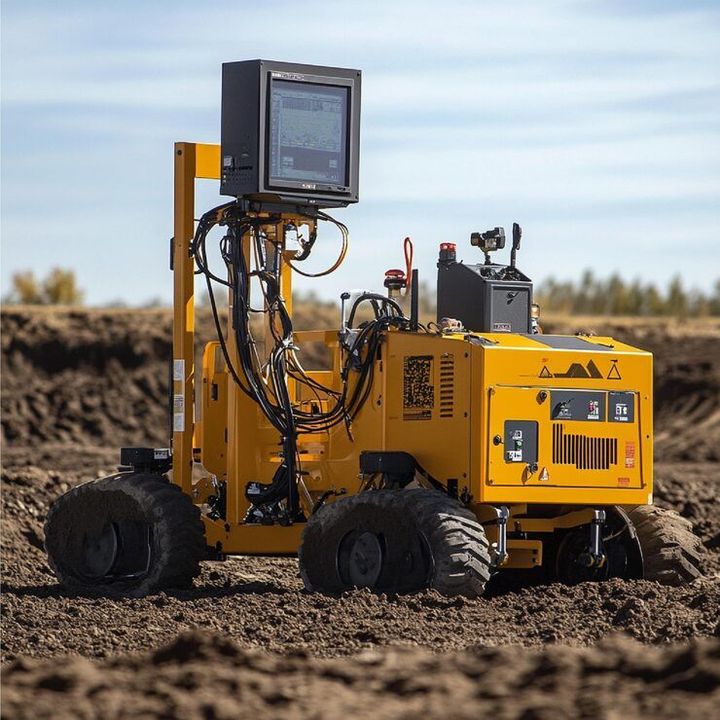
Portable instruments are useful when engineers need to investigate several locations across a large construction site. Modern field systems can combine electronic measurement, digital records, and location information.
Cone penetration testing, for example, measures resistance as a cone is pushed into the ground. Depending on the equipment, additional sensors can provide information about sleeve friction and pore pressure.
Field testing can produce detailed ground profiles, although it does not eliminate the need for laboratory testing in every project.
Data Analysis and Predictive Modelling
Geotechnical engineers increasingly use numerical modelling and data analysis to understand complex ground conditions.
Digital tools can help organize laboratory results, compare soil layers, estimate settlement, and evaluate alternative engineering scenarios. Artificial intelligence may assist with identifying patterns in large datasets, but its predictions require appropriate validation against reliable measurements and established engineering principles.
No single instrument or software model can accurately represent every geological condition.
Sustainability and Ground Improvement
Another important development is the growing attention given to the environmental performance of construction materials and ground improvement techniques.
Engineers may investigate soil stabilization, recycled materials, lower-impact binders, and methods that reduce unnecessary excavation. Geotechnical testing helps assess whether these approaches achieve the required engineering properties.
The suitability of any technique depends on soil chemistry, groundwater conditions, environmental requirements, and project specifications.
Laws, Regulations, and Testing Standards
Building Regulations and Geotechnical Investigation
Geotechnical testing requirements vary by country, region, and project type. Building regulations may require a site investigation, foundation assessment, or engineering report before construction approval.
In India, the National Building Code of India provides a framework for building safety, including structural and foundation-related considerations. Relevant provisions must be interpreted alongside applicable local building regulations and approval requirements.
The Bureau of Indian Standards publishes technical standards relevant to soil investigation and testing. Commonly referenced documents include IS 2720, which covers methods of test for soils, and IS 1892, which addresses subsurface investigation for foundations.
Engineers should verify the applicable edition, amendments, and project-specific requirements before selecting a testing procedure.
International Testing Standards
Internationally recognized standards help laboratories and engineering teams use consistent testing procedures.
Examples include:
ASTM International standards for soil classification, strength, compaction, and other geotechnical tests.
ISO standards relating to geotechnical investigation and testing.
European geotechnical standards, including Eurocode 7, for geotechnical design principles.
These standards are not automatically interchangeable. The required method depends on the governing regulations, contract specifications, and engineering design framework.
Laboratory Quality and Equipment Calibration
Reliable results require more than modern machinery. Laboratories should maintain documented procedures, calibrated measuring instruments, trained personnel, and appropriate quality control.
ISO/IEC 17025 is an internationally recognized standard for the competence of testing and calibration laboratories. Accreditation under this standard applies to the laboratory's defined scope rather than automatically covering every test it performs.
Testing reports should identify the methods used, relevant sample details, measurement results, and any limitations that could affect interpretation.
Tools and Resources for Soil Testing
Essential Laboratory and Field Tools
Several categories of tools support geotechnical investigation:
Sample collection equipment: Used to obtain disturbed or relatively undisturbed soil specimens.
Moisture measurement tools: Determine the water content of soil samples.
Density measurement instruments: Assess laboratory or field soil density.
Mechanical loading frames: Apply controlled loads during strength and deformation tests.
Penetration instruments: Measure resistance as a probe enters the ground.
Groundwater monitoring equipment: Helps observe groundwater levels and changes over time.
Digital data acquisition systems: Record measurements and organize test results.
Software and Calculation Resources
General engineering software and calculation tools can support the interpretation of soil test results.
Useful categories include spreadsheet templates for laboratory records, soil classification calculators, compaction curves, settlement estimation tools, slope stability models, and foundation analysis programs.
A typical soil investigation record should include:
Sample identification and collection location
Soil description and classification
Test method and standard used
Moisture content and density measurements
Applied loads and recorded deformation
Test date and equipment calibration information
Interpretation notes and limitations
Calculators and software should support, rather than replace, engineering judgment. Input data, assumptions, and calculation methods need to be checked before results are used in design.
Frequently Asked Questions
What Are Geotechnical Testing Machines Used For?
They measure soil properties such as strength, density, moisture content, permeability, and compressibility. Engineers use the results to investigate foundations, roads, slopes, embankments, and other structures.
Which Soil Test Is Most Important for Foundation Design?
There is no single test that is best for every foundation. The investigation may include soil classification, shear strength testing, penetration testing, groundwater observations, and consolidation tests. The appropriate combination depends on the ground conditions and structural loads.
What Is the Difference Between Field Testing and Laboratory Testing?
Field testing evaluates ground conditions at the site, often providing information about soil layers and in-place behavior. Laboratory testing examines collected specimens under controlled conditions. Both methods provide complementary information.
How Often Should Geotechnical Testing Equipment Be Calibrated?
Calibration intervals depend on the instrument, manufacturer recommendations, applicable standards, laboratory quality procedures, and the equipment's use. Laboratories should maintain documented calibration records and perform checks at appropriate intervals.
Can Soil Testing Prevent Foundation Problems?
Soil testing helps identify potential risks and provides evidence for foundation design. It cannot eliminate every risk because ground conditions may vary, construction practices can differ, and unexpected geological features may occur. Appropriate investigation, design, supervision, and monitoring work together to improve safety.
Conclusion
Geotechnical testing machines are essential tools for understanding how soil responds to loading, moisture, and environmental changes. Compaction, shear strength, triaxial, consolidation, CBR, and permeability tests each provide information that supports different engineering decisions.