Automated Screwdriving Systems: Components and Control Methods
Automated screwdriving systems are industrial technologies designed to tighten screws and fasteners with limited manual intervention. They are used in manufacturing environments where products require consistent fastening, repeatable assembly steps, and controlled tightening forces. These systems combine mechanical equipment, electric or pneumatic screwdrivers, sensors, controllers, and specialized software.
Automated systems address these challenges by following programmed instructions and monitoring important fastening parameters. Depending on the application, they can operate as standalone stations, integrated robotic cells, or components of larger production lines.
Common applications include automotive assembly, electronics manufacturing, household appliances, industrial machinery, medical equipment, and precision engineering. Each application has different requirements for screw size, material, tightening torque, production speed, and inspection.
The main purpose is not simply to tighten screws faster. It is to make fastening operations more repeatable, traceable, and suitable for consistent manufacturing quality.
Importance of Automated Screwdriving in Modern Manufacturing
Fastening is a small but essential part of many industrial products. A loose screw can cause vibration, leakage, electrical problems, or mechanical failure. Excessive tightening may damage threads, crack components, or deform sensitive materials.
Automated screwdriving systems help manufacturers manage these risks through controlled processes.
Improving assembly consistency
A programmed system can apply a defined tightening sequence across repeated production cycles. When correctly configured, it reduces variation caused by differences in manual technique.
Supporting production efficiency
Automated equipment can perform repetitive fastening operations without requiring an operator to complete every individual tightening step. This can help maintain a predictable production flow and reduce unnecessary handling.
Protecting sensitive components
Electronic devices, plastic housings, lightweight metal assemblies, and precision instruments may require carefully controlled tightening. Sensors and programmable drivers help prevent excessive force from damaging these components.
Improving quality control
Modern systems can record information such as tightening torque, rotation angle, cycle duration, and fastening status. These records help identify abnormal results and support investigation when an assembly does not meet its specifications.
Supporting worker safety and ergonomics
Repeated manual fastening can involve wrist movement, awkward positioning, and exposure to tool vibration. Automation can reduce some repetitive tasks, although safe machine design and appropriate human supervision remain necessary.
Automated screwdriving is particularly valuable in production environments where fastening quality directly affects reliability, product performance, and compliance requirements.
Main Components of an Automated Screwdriving System
An automated screwdriving system consists of several connected components. Each part performs a specific function, from delivering screws to checking whether the fastening operation has been completed correctly.
1. Screwdriving tool and spindle
The screwdriver is the main fastening component. It rotates the screw and applies the required torque. Electric screwdrivers are commonly used where precise electronic control and process monitoring are important. Pneumatic tools use compressed air to generate rotational movement.
A spindle may be mounted on a fixed assembly station or attached to a robotic arm. The correct tool depends on screw dimensions, material properties, tightening requirements, and production conditions.
2. Automatic screw feeder
A screw feeder organizes and delivers individual fasteners to the screwdriver. It may use vibration, mechanical tracks, or other feeding mechanisms to position screws for pickup.
Reliable feeding helps prevent missing screws, incorrect orientation, and interruptions during assembly. Feeder design must match the screw's shape, size, and surface characteristics.
3. Positioning and robotic equipment
Positioning equipment brings the screwdriver into alignment with the fastening point. This may involve linear slides, indexing tables, fixtures, or industrial robots.
Robotic screwdriving systems are useful when a product contains multiple fastening locations or when different products share an assembly station. Accurate positioning reduces the risk of cross-threading and damage to threaded holes.
4. Torque and angle sensors
Torque sensors measure the rotational force applied during tightening. Angle measurement tracks how far the screw rotates during a fastening cycle.
Together, these measurements help determine whether a screw has reached the programmed tightening conditions. They can also reveal unusual fastening behavior, although the measurements must be interpreted according to the joint design.
5. Programmable logic controller and control unit
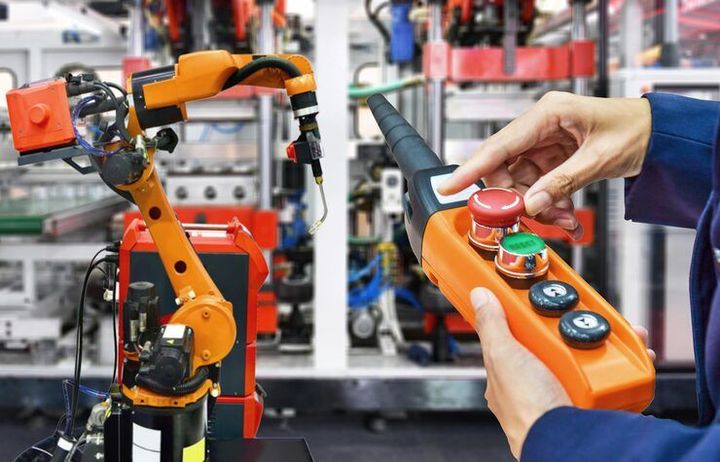
A programmable logic controller (PLC) coordinates the sequence of operations. It can communicate with sensors, motors, robotic equipment, safety devices, and production-line controls.
The fastening controller manages parameters such as torque limits, rotational speed, tightening angle, and cycle status. More advanced systems can store different programs for different product models.
6. Human-machine interface and data system
A human-machine interface (HMI) allows authorized operators to select programs, monitor production status, and review alarms. A connected data system may record fastening results for quality analysis and traceability.
The interface should display clear information about completed cycles, rejected fasteners, and equipment faults.
Component | Main function | Quality contribution |
|---|---|---|
Screwdriver spindle | Rotates and tightens screws | Controlled fastening |
Screw feeder | Presents screws in sequence | Fewer feeding interruptions |
Positioning system | Aligns the tool | Better screw engagement |
Torque sensor | Measures rotational force | Identifies torque deviations |
PLC and controller | Coordinates operations | Repeatable process sequence |
HMI and data system | Displays and records results | Easier monitoring and traceability |
Control Methods Used in Automated Screwdriving
Control methods determine how a system tightens screws and decides whether a fastening operation meets its programmed requirements. The appropriate method depends on the joint, fastener, and acceptable quality limits.
Torque control
Torque control stops the tightening operation when the measured rotational force reaches a specified target or limit. It is widely used because torque is directly related to the force that can develop within a threaded joint.
However, friction between screw threads and contact surfaces affects the relationship between torque and clamping force. Reaching the correct torque does not automatically guarantee the desired joint condition.
Angle control
Angle control monitors screw rotation after a defined starting point or tightening stage. It can help identify abnormal movement, including unexpectedly early resistance or excessive rotation.
This method is often used alongside torque monitoring to improve process evaluation.
Torque-and-angle control
Combined torque-and-angle control checks both measurements against defined limits. For example, a controller may require the screw to reach a specified torque while remaining within an acceptable rotation-angle range.
This approach can help identify cross-threading, missing components, incorrect seating, or other unusual fastening conditions. The precise detection capability depends on the joint and the control program.
Position and sequence control
Position control directs the screwdriver to specific fastening locations. Sequence control ensures that operations occur in the required order.
These methods are especially useful for assemblies with several screws, different fastener types, or strict assembly instructions.
Adaptive and data-based control
Advanced systems analyze sensor readings and fastening results to identify changing process conditions. Depending on the equipment, they may support automatic parameter adjustments, fault detection, or maintenance alerts.
Such functions require appropriate validation. Automated adjustments should not override approved fastening limits or safety requirements.
Recent Updates and Industrial Trends
Developments during 2025 and 2026 have continued to emphasize connected production equipment, flexible robotics, and data-based quality monitoring.
More flexible robotic assembly
Manufacturers increasingly explore robotic screwdriving for products with changing designs and multiple fastening points. Programmable motion and modular tooling can support changes between assembly tasks without rebuilding an entire station.
Improved vision and screw detection
Machine vision can help identify fastening locations, check component orientation, and guide robotic positioning. Its usefulness depends on lighting, surface reflections, camera placement, and the visibility of the target.
Greater process traceability
Connected controllers can associate fastening results with a production sequence or individual assembly. This helps quality teams investigate recurring defects and identify patterns across manufacturing batches.
Digital twins and virtual commissioning
Research published in March 2026 examined digital-twin integration for robotic fastening systems, highlighting opportunities to connect process monitoring with broader engineering decisions. Digital models can help engineers evaluate system behavior and plan changes before applying them to physical equipment.
Laws, Policies, and Safety Standards
Automated screwdriving systems must be designed and operated according to applicable machinery safety, workplace health, and product-quality requirements. The exact obligations depend on the country, industry, equipment design, and intended application.
International machinery and robot safety standards
ISO 10218-1:2025, published in February 2025, addresses safety requirements for industrial robots. ISO 10218-2:2025 covers the integration and safety of industrial robot applications and robot cells. These standards are relevant when screwdriving equipment uses industrial robots.
Fastening tool performance
ISO 5393:2017 provides a performance test method for power assembly tools used with threaded fasteners. It addresses torque repeatability and, where applicable, the precision of built-in torque measurement systems. The standard was reviewed and confirmed in 2023.
Indian workplace requirements
In India, factories and industrial workplaces must consider applicable occupational safety legislation, machinery requirements, and relevant state rules. The Occupational Safety, Health and Working Conditions Code, 2020, is part of India's consolidated labour-law framework; its applicability must be assessed alongside the commencement notifications and rules in force.
Manufacturers should verify current legal requirements before installing or modifying automated equipment. Industry-specific obligations may also apply to automotive components, electronics, medical devices, and other regulated products.
Tools and Resources for System Planning
Several general engineering resources can help teams select, configure, and maintain automated screwdriving systems.
Torque calculation worksheets: Help document the target torque, allowable limits, fastener dimensions, and joint requirements.
Fastening process checklists: Record screw presence, tool alignment, tightening sequence, and inspection criteria.
PLC programming environments: Define the operating sequence and communication between sensors, controllers, and positioning equipment.
Statistical process control tools: Track torque readings, cycle results, defect rates, and variations over time.
Machine vision software: Supports screw-location detection, component orientation checks, and robotic guidance.
Maintenance logs: Track tool calibration, feeder faults, worn driver bits, sensor performance, and equipment inspections.
Digital simulation tools: Help evaluate robot movements, workstation layouts, and possible interference before physical implementation.
Before selecting equipment, engineers should document screw specifications, target torque, required cycle time, product variations, available workspace, and inspection needs. Testing on representative joints is essential because identical torque settings may produce different clamping forces under different surface and material conditions.
Frequently Asked Questions
1. What is an automated screwdriving system?
It is a machine or integrated assembly station that tightens screws using controlled tools, mechanical positioning, sensors, and programmed instructions. Some systems operate independently, while others use industrial robots.
2. How does torque control improve fastening quality?
Torque control monitors rotational force and stops tightening when a programmed condition is reached. It helps maintain consistency, but torque alone cannot confirm every aspect of joint quality.
3. What is the difference between torque control and angle control?
Torque control measures rotational force, while angle control measures screw rotation. Using both measurements can provide additional information about the fastening process.
4. Which industries use automated screwdriving equipment?
Common applications include automotive manufacturing, electronics assembly, household appliances, industrial machinery, and precision equipment production. Requirements differ according to the product and fastening joint.
5. How often should automated screwdriving systems be checked?
Inspection and calibration intervals depend on the equipment manufacturer's guidance, production conditions, process criticality, and applicable quality requirements. Regular checks should include tool performance, sensor accuracy, fastener feeding, and safety functions.
Conclusion
Automated screwdriving systems combine mechanical tools, positioning equipment, sensors, controllers, and monitoring software to improve the consistency of industrial fastening. Their effectiveness depends on selecting appropriate components, establishing suitable control methods, and validating the complete fastening process.